Louisiana Rural Clinician Credit Bank: Matching Funds for Rural Hiring
November 20, 2026 · 8 min read · Applichat Labs
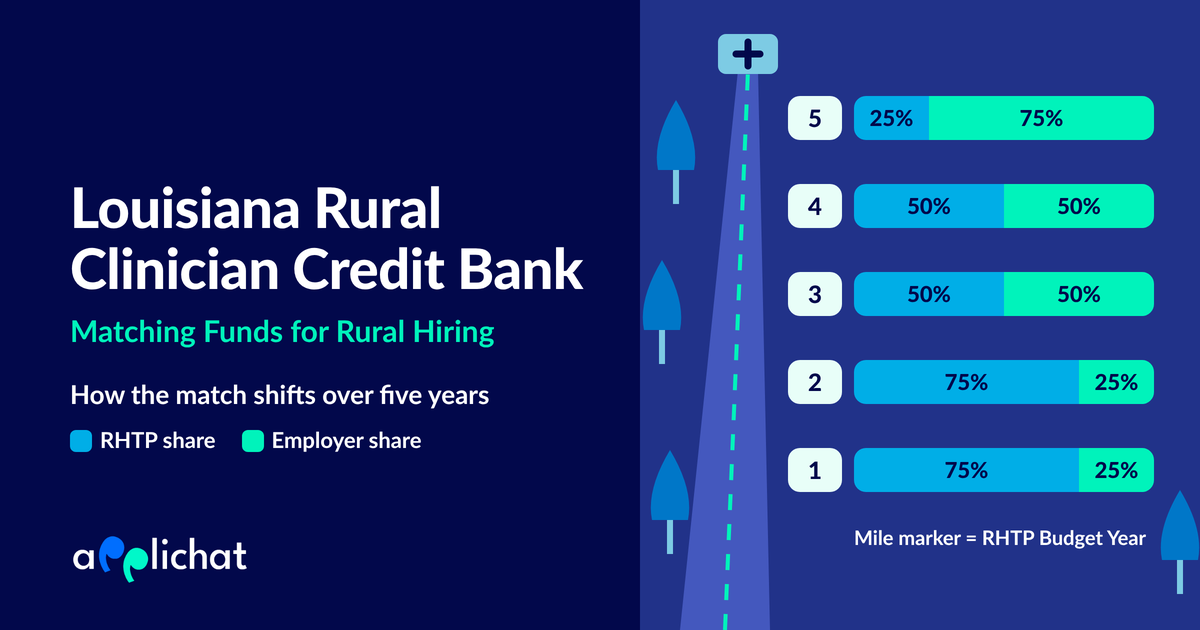
Picture a five-year road trip with a co-driver who covers 75% of the gas for the first two years and 25% in the last year. By the final stretch, the tank is mostly on you. That is the shape of the match in Louisiana’s Rural Clinician Credit Bank, and the trip goes better when the gas budget is set before anyone leaves the driveway.
The short answer: The Louisiana Rural Clinician Credit Bank is reimbursement-based matching funds from the Louisiana Department of Health (LDH) for rural employers’ sign-on bonuses, retention bonuses, relocation costs, and training stipends. Clinicians sign a five-year service commitment. RHTP pays 75% in RHTP Budget Years 1 and 2 and 25% in Budget Year 5. The first window closed in June 2026, so confirm current status with LDH before you build an offer.
Key Facts
| Item | Detail |
|---|---|
| Program | Rural Clinician Credit Bank (RCCB); listed as “Rural Clinician Bank” on the LDH Rural Health Transformation Program page |
| State | Louisiana |
| Administered by | Louisiana Department of Health, Office of Rural Health Transformation and Sustainability |
| Type | Reimbursement-based matching funds paid to employers |
| What it funds | Sign-on bonuses; retention bonuses; relocation or transition costs; training or certification stipends |
| Who can apply | Rural employers that meet Louisiana’s RHTP rural definition (see below) |
| Funds available | $5,630,000, per the NOFO |
| Commitment | Five-year service commitment for staff who receive payments |
| Enrollment | Open enrollment; applications reviewed on a rolling basis as funding remains available |
| First window | Closed in June 2026 |
| Year 1 funds | Must be spent by September 30, 2027 |
| Contact | RuralHealthTransformation@la.gov |
| Official source | NOFO, Version 1.0, May 15, 2026 |
Facts as of November 20, 2026. Confirm current status with LDH (RuralHealthTransformation@la.gov).
What Is the Louisiana Rural Clinician Credit Bank?
It is one of Louisiana’s RHTP workforce incentives. LDH’s Office of Rural Health Transformation and Sustainability runs it. The NOFO states plainly: “This is a reimbursement-based program.” The employer pays the clinician first, and LDH reimburses its share afterward.
LDH announced the program on June 3, 2026 as a $5.6 million fund. If you searched for “Rural Clinician Bank Louisiana,” this is the same program.
Who Can Apply?
Employers apply, not clinicians. The NOFO lists:
- Rural health clinics and rural FQHCs
- Critical access hospitals, small rural hospitals, and Rural Emergency Hospitals
- Other rural providers, including behavioral health and substance use disorder providers, independent physician groups, dental offices, pharmacies, EMS, and PACE programs
Every applicant must qualify as rural under Louisiana’s RHTP definition.
How Much Can an Employer Receive per Clinician?
The NOFO lists a “Maximum Total Reimbursement Amount” for each staff type. It also recommends financial support of “up to 25% of annual base salary.”
| Staff type | Maximum per clinician, as listed in the NOFO |
|---|---|
| Physician (MD/DO) | $75,000 |
| Dentist | $60,000 |
| Nurse practitioner | $50,000 |
| Physician assistant | $50,000 |
| Mental and behavioral health professional | $45,000 |
| Registered nurse | $30,000 |
| Dental hygienist | $25,000 |
| Allied health professional | $25,000 |
| Licensed practical nurse | $20,000 |
| Paramedic or EMT | $20,000 |
| Certified nursing assistant or nurse aide | $10,000 |
Source: LDH NOFO, Section C.3. The NOFO says RHTP pays its share “up to the maximum reimbursement amount for clinician type.” Ask LDH how that cap applies to your offer.
How Does the Employer Match Work?
This is the part that decides your budget. The share of Louisiana rural sign-on bonus matching funds shifts toward the employer over five RHTP Budget Years.
| RHTP Budget Years | Employer share | RHTP share |
|---|---|---|
| 1 and 2 | 25% | 75% |
| 3 and 4 | 50% | 50% |
| 5 | 75% | 25% |
Source: LDH NOFO.
Put simply, for every dollar, the employer pays 25 cents and RHTP pays 75 cents in Budget Years 1 and 2. The NOFO labels these as RHTP Budget Years, not as years of the clinician’s service. Ask LDH how the schedule applies to payments you make across a clinician’s five years.
What Happens If a Clinician Leaves Early?
The five-year commitment has teeth. Per the NOFO, staff who leave early must return part of the bonus:
- Less than two years after signing: 80%
- Two to three years: 70%
- Three to four years: 60%
- Four to five years: 50%
The employer collects the repayment and returns the matching funds to the state. Your offer letter and onboarding plan need to say this clearly.
Plan Year Five on Day One
Back to the road trip. The employer’s share triples, from 25% in RHTP Budget Years 1 and 2 to 75% in Budget Year 5. A retention bonus promised for later in a clinician’s commitment may be paid in a budget year with a smaller RHTP share. Price the offer at each rate before you make it.
| Not that | Do this |
|---|---|
| Build the offer around the physician maximum and stop there | Budget your share at 25%, 50%, and 75% before you make the offer |
| Assume the program is open because the NOFO says “rolling” | Email RuralHealthTransformation@la.gov and confirm status and remaining funds first |
| Treat the bonus as the retention plan | Pair it with housing, spouse job leads, and a local welcome |
| Mention repayment at signing only | Explain the 80% to 50% repayment tiers during recruiting |
Retention is what makes five years possible. Our RN hires are 88% retained at one year. A bonus gets a clinician to town; housing and community keep them there. Our guide to who owns each reason a rural clinician stays assigns housing, spouse jobs, and the welcome, and our article on why relocation fails without community integration covers what keeps people past year one.
Who Needs a Seat at the Table?
A matching fund is a state-and-employer deal on paper. In practice, five years in a rural town takes more partners.
- The state. LDH’s Office of Rural Health Transformation and Sustainability sets the rules and pays the RHTP share. Talk to them before you offer, not after.
- The employer. You apply, pay the bonus, carry the rising match, and hold the clinician’s commitment.
- Training providers. Training and certification stipends are a route to grow local staff, for example, a CNA moving toward LPN with a nearby community college. Bring the college in when you plan the stipend.
- The community. A five-year commitment is a five-year stay in a town. Housing, schools, and a real welcome decide whether it lasts. Local leaders can help with all of it.
- Conveners. Hospital associations and Primary Care Associations could help small members model the match before they apply. A clinic with one HR person gains a lot from a shared budget template.
Tribal health organizations should ask LDH whether they fit the “other rural providers” category.
For how Louisiana compares with other states, see our RHTP workforce funding by state guide and Missouri’s ToRCH Care retention funding.
Frequently Asked Questions
What is the Louisiana Rural Clinician Credit Bank?
It is a Louisiana Department of Health program that reimburses rural employers for part of the cost of sign-on bonuses, retention bonuses, relocation costs, and training or certification stipends. LDH’s Office of Rural Health Transformation and Sustainability runs it with RHTP funds. The NOFO lists $5,630,000 available.
Who can apply?
Rural employers apply, including rural health clinics, rural FQHCs, critical access hospitals, small rural hospitals, and Rural Emergency Hospitals. Other rural providers can apply too, such as behavioral health, independent physician groups, dental offices, pharmacies, EMS, and PACE programs. All must meet Louisiana’s RHTP rural definition.
How much can an employer receive per clinician?
The NOFO lists a maximum per clinician type, from $75,000 for a physician (MD/DO) to $10,000 for a certified nursing assistant. Nurse practitioners and physician assistants are $50,000 each, and registered nurses are $30,000. Confirm with LDH how the maximum applies to your offer.
How does the employer match work over five years?
The employer pays 25% and RHTP pays 75% in RHTP Budget Years 1 and 2. The split is 50/50 in Budget Years 3 and 4. In Budget Year 5, the employer pays 75% and RHTP pays 25%.
Is it still accepting applications?
The first application window closed in June 2026. The NOFO describes open enrollment with rolling review “as funding remains available,” and it notes that applying does not guarantee funding. Confirm current status with LDH at RuralHealthTransformation@la.gov before you plan an offer.
What does the clinician commit to?
Staff who receive payments sign a five-year service commitment. Those who leave early repay part of the bonus, from 80% within two years of signing to 50% between four and five years. The employer collects the repayment and returns the matching funds to the state.
Is the Rural Clinician Credit Bank a tax credit?
No. Per the NOFO, it is reimbursement-based matching funds paid to employers.
What is the Year 1 funds period?
The NOFO gives the Year 1 funds period as August 1, 2026 to September 30, 2027, so Year 1 funds must be spent by September 30, 2027. Check the official notice or ask LDH how the period applies to your award.
Plan the Offer Before You Apply
Applichat Labs helps rural employers relocate clinicians, publicize training opportunities, and recruit well on their own. Our Rural Health Transformation Hub is an advisory service of Applichat Labs, separate from LDH, and has advised 35 providers. Book a Hub call to plan your offer and your five-year match before you apply.
Want help with work like this?
We help healthcare teams hire better and work smarter. Book a call and we'll walk through what we can do for a team like yours.