
Missouri Workforce Retention and Enablers Funding: ToRCH Care Guide
November 19, 2026 · 7 min read · Applichat Labs
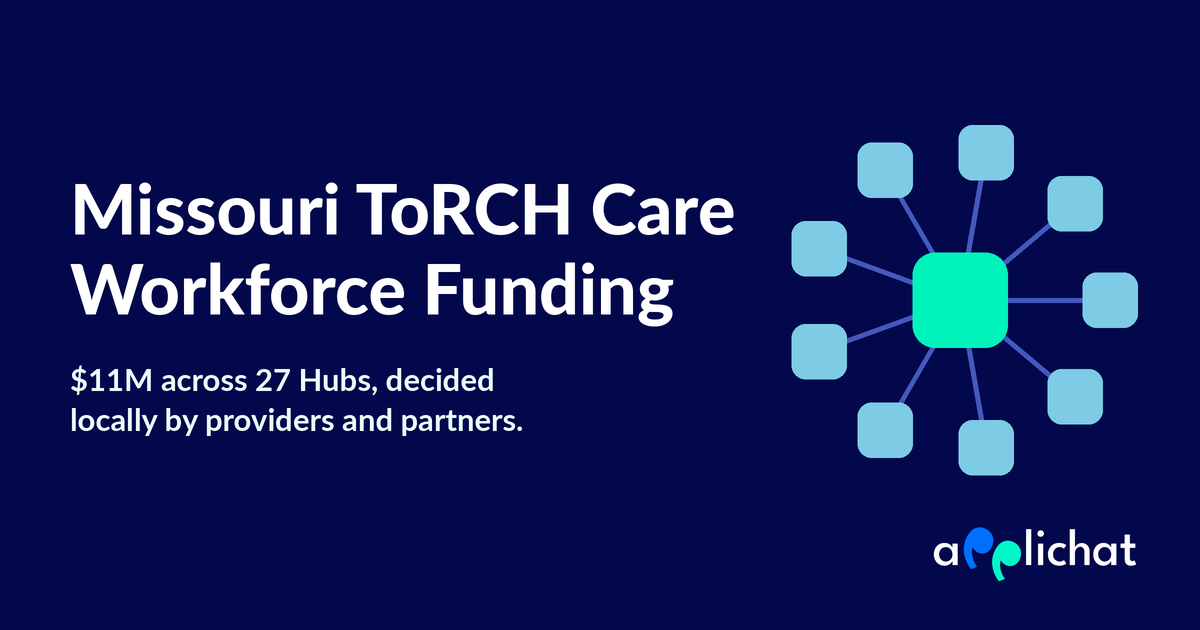
Most workforce grants hand one organization a check and wish it luck. Missouri set a different table. Its new workforce funding goes to 27 local Hubs, and the providers and community partners in each Hub decide together what to spend it on.
The short answer: Missouri’s ToRCH Care Workforce Retention and Enablers funding is about $11 million from the state’s Rural Health Transformation Program to help rural employers recruit and keep their rural health workforce. Each of Missouri’s 27 ToRCH Care Hubs is allocated about $412,000 over two program years, contingent on CMS year 2 approval. Rural providers and community partners propose projects through their local Hub, and the proposal window runs November 2 to November 22, 2026 (Missouri DSS, October 29, 2026).
Key Facts
| Item | Detail |
|---|---|
| Program | Workforce Retention and Enablers funding, part of Missouri’s ToRCH Care Rural Health Transformation Program |
| Administered by | Missouri Department of Social Services (DSS) Rural Health Transformation Office, in partnership with Healthier Communities Together (HCT) |
| Total | About $11 million |
| Per Hub | About $412,000 over two program years, contingent on CMS year 2 approval |
| Eligible areas | Housing assistance; training and retention; transportation; workplace organizational support; innovative, locally designed workforce solutions |
| Who can take part | Rural hospitals, clinics, behavioral health organizations, EMS agencies, pharmacies, other healthcare providers, and community partners, through their local Hub |
| Provider proposals | November 2 to November 22, 2026 |
| Hub proposal to HCT | By December 7, 2026 |
| Official source | Missouri DSS announcement and Missouri’s Rural Health Transformation Program page |
Facts as of November 18, 2026. Program details are subject to final program guidance and federal requirements. Check the official pages for updates.
What Is Missouri’s ToRCH Care Program?
ToRCH Care is the name of Missouri’s Rural Health Transformation Program. Missouri received more than $216 million in first-year funding from CMS, and DSS leads the effort through the MO HealthNet Division with support from DHSS and DMH (Missouri DSS).
The program is built around 27 local community Hubs spanning 104 counties, supported by Regional Coordinating Networks. Rural health workforce programs are one of its five strategic pillars, with the goal to “train, recruit, and keep health care workers in rural areas.”
What Can the Workforce Retention and Enablers Funding Pay For?
Subject to final guidance, eligible proposals may address five areas:
- Housing assistance, such as helping new hires secure housing
- Training and retention, such as supporting staff development
- Transportation
- Workplace organizational support, such as improving workforce well-being
- Innovative, locally designed workforce solutions, such as piloting shared recruitment approaches
The funding is meant to address needs not already covered by other Missouri RHTP workforce programs. Certain individual benefits may require a five-year rural service commitment; DSS said more detail would come in the proposal guidance.
Who Needs a Seat at Each Hub’s Table?
This is where Missouri’s design stands out. The state did not prescribe one statewide solution. Each Hub directs its share toward the workforce barriers that matter most in its own communities (Missouri DSS).
- Providers identify their workforce challenges and propose solutions through the Hub Program Coordinator.
- Community partners help shape the proposals alongside providers. Housing, transportation, and a welcome for new staff are community work as much as hospital work.
- Hub Anchors coordinate the proposals.
- Hub Leadership Boards review and prioritize projects based on community need, expected impact, and available funding.
- HCT and the state review the combined Hub proposal and give final approval.
That is a workforce table with every seat named. It matches what we see work across rural regions: no single hospital can solve housing, transportation, and training on its own, but a Hub that brings employers, community groups, and training partners together can. Our guide to who needs a seat at the rural health workforce table covers the same idea for any state.
What Are the Key Dates?
| Dates | Step |
|---|---|
| November 2 to November 22, 2026 | Providers complete the proposal template with their Hub |
| November 23 to December 7, 2026 | Hub Leadership Boards review proposals and adjust as needed |
| By December 7, 2026 | Hub Anchor or Program Coordinator submits one Leadership Board-approved Hub proposal to HCT |
| December 7 to December 18, 2026 | HCT reviews; the Rural Health Transformation Office gives final approval; participation agreements are signed before the CMS December 31 deadline |
Source: Missouri DSS, October 29, 2026.
How Can a Rural Provider or Community Partner Take Part?
- Find your Hub. Missouri publishes the Hub county groupings and Regional Coordinating Networks.
- Contact your Hub Program Coordinator before November 22 to share your workforce needs and get the proposal template.
- Bring partners with you. A housing proposal is stronger with the landlord, employer, and community group already named. A training proposal is stronger with the local college at the table.
- Pick one barrier and one measure. Name the problem (for example, new hires turning down offers for lack of housing) and the number you expect to move.
- Plan for the commitment rules. If your idea includes individual benefits, check whether a five-year rural service commitment applies.
How Do These Uses Connect to Recruitment and Retention?
Each eligible area maps to a reason rural roles go unfilled or turn over. Housing assistance removes one of the most common reasons a candidate says no. Training and retention funding supports the staff already in place. Shared recruitment pilots let a Hub make its case to candidates once, together, instead of competing hospital by hospital. For examples of what works, see rural healthcare relocation programs that improve retention and why relocation fails without community integration.
Frequently Asked Questions
What is Missouri’s Workforce Retention and Enablers funding?
It is about $11 million in Missouri Rural Health Transformation Program funding, announced by the Missouri Department of Social Services on October 29, 2026, to help rural healthcare organizations recruit and retain workers. Each of the 27 ToRCH Care Hubs is allocated about $412,000 over two program years, contingent on CMS year 2 approval.
What is a ToRCH Care Hub?
ToRCH Care Hubs are the 27 local community Hubs at the center of Missouri’s Rural Health Transformation Program, spanning 104 counties. Each Hub has a Hub Anchor, a Program Coordinator, and a Leadership Board that brings local providers and partners together.
What can the funding be used for?
Subject to final program guidance, proposals may address housing assistance; training and retention; transportation; workplace organizational support; and innovative, locally designed workforce solutions. Examples include housing for new hires, staff development, workforce well-being, and shared recruitment pilots.
Who can apply?
Rural hospitals, clinics, behavioral health organizations, EMS agencies, pharmacies, other healthcare providers, and community partners can take part through their local Hub. Providers submit proposals to their Hub, and the Hub submits one combined proposal.
When are proposals due?
Providers complete the proposal template between November 2 and November 22, 2026. Hub Leadership Boards review proposals through December 7, and the Hub submits one approved proposal to Healthier Communities Together by December 7, 2026.
How does this fit rural health workforce transformation?
Missouri routes the money through 27 local Hubs, so providers, community partners, and training partners decide together which workforce barriers to fund. That is the same systems approach behind durable rural health workforce transformation: no single employer can solve housing, transportation, and training alone. See our field guide to rural health workforce transformation.
Do individual benefits require a service commitment?
Certain individual benefits may require a five-year rural service commitment, according to Missouri DSS. Check the final proposal guidance from your Hub for details.
Get Help Shaping Your Hub Proposal
Applichat Labs helps rural employers and conveners turn workforce funding into permanent hires through staff relocation, publicizing training opportunities, and recruitment technical assistance. Our RN hires are 88% retained at one year. Applichat Labs’ Rural Health Transformation Hub, an advisory service separate from Missouri’s ToRCH Care Hubs, has advised 35 providers. Book a call to work through your proposal.
Want help with work like this?
We help healthcare teams hire better and work smarter. Book a call and we'll walk through what we can do for a team like yours.